

20-Foot vs. 32-Foot Mobile Kitchen Trailer: What Size Do You Actually Need?
The most common sizing mistake with a temporary kitchen is not picking a trailer that is too small. It is picking one without first answering three simple questions: how many meals per service, how complex is the menu, and what else — prep, dishwashing, and cold storage — has to happen on site?
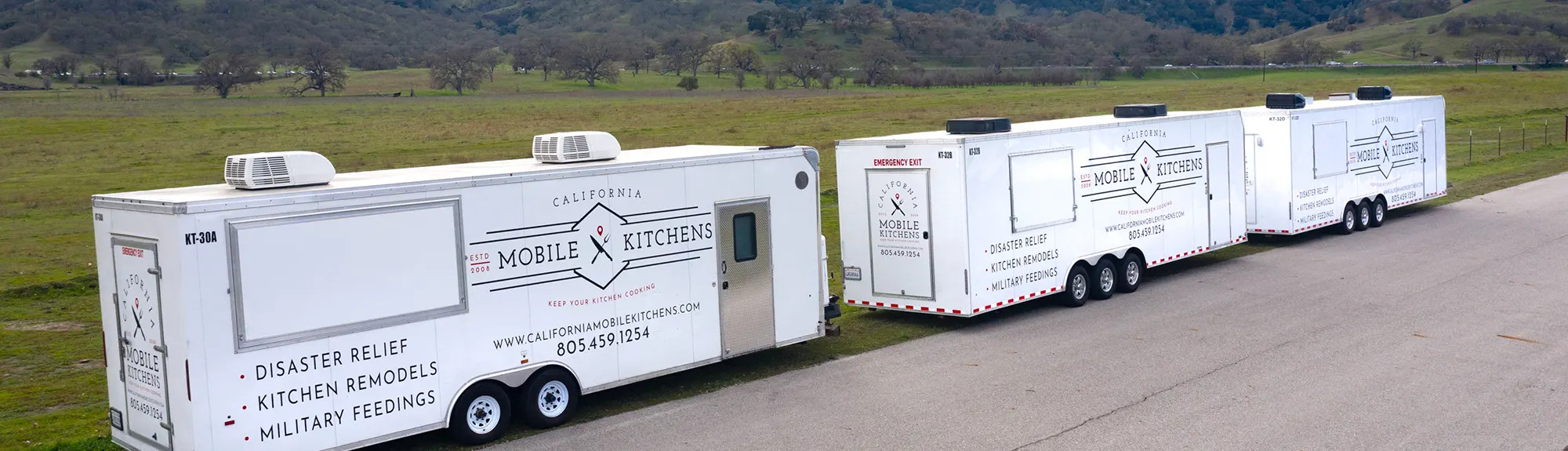
California Mobile Kitchens (CMK) rents two main kitchen trailer sizes. Both are fully equipped commercial kitchens, delivered and set up at your site, and built to meet or exceed state and county health department requirements. The difference is capacity and working room.
The two sizes at a glance
20-foot kitchen trailer — $6,000 per month. A compact, fully equipped commercial kitchen that serves 1–300 meals per meal. Exterior dimensions are 9 feet by 25 feet, with 170 square feet of interior space.
32-foot kitchen trailer — $8,000 per month. A full-size commercial kitchen that serves up to 1,000 meals per service.
Delivery and setup are covered in the lease agreement, so the full pricing — including delivery and setup — is in the lease before you sign.
Start with meals per service, not meals per day
Sizing runs on your busiest single service, not your daily total. A school serving 250 lunches in one sitting is a different job from a site serving 250 meals spread across three small services.
- If your busiest service is 300 meals or fewer, the 20-foot trailer is built for that load.
- If your busiest service runs above 300 meals, up toward 1,000, the 32-foot trailer gives you the cooking capacity and the working room to keep up.
- If you are close to the line, say so when you request a quote. Menu and staffing can tip the answer — a simple menu at 300 covers differently than a multi-item menu at 300.
Then look at your menu
Meal count alone does not decide size. A short menu with a few items moves faster in a smaller kitchen than a long menu with several cooking methods running at once.
Ask yourself:
- How many hot items are cooking at the same time?
- How much prep happens on site, versus arriving prepped?
- How many staff need to work in the kitchen at once?
If prep is heavy, you do not always need a bigger kitchen trailer — you may need prep space. CMK's 32-foot prep kitchen trailer (9 feet by 37 feet, 272 square feet of interior space) supports operations serving up to 1,000 meals per service and pairs with a kitchen trailer on larger jobs, adding room to wash, chop, mix, assemble, and stage food.
Do not forget dishwashing and cold storage
A kitchen trailer cooks. It does not include a dishwasher — dishwashing gets its own dedicated 24-foot dishwashing trailer, so plates, pots, and utensils keep moving without slowing down cooking.
Cold storage is separate too. CMK rents 12-foot and 16-foot refrigeration and freezer trailers for ingredients, prepared food, and finished product.
That separation is a sizing advantage: you add only the support trailers your job actually needs, instead of paying for one oversized unit that tries to do everything.
Check your site before you decide
Both kitchen trailer sizes use the same standard utility profile, which makes site planning straightforward:
- Power: 208–220V single-phase, 50-amp
- Fresh water: 3/4-inch connection
- Wastewater: 1 1/2-inch connection
- Propane: where required
You also need a level setup area. Tell us about your site when you request a quote and we will confirm what your setup needs. If your site has no sewer connection, ask about the 250-gallon wastewater tank option. Available add-ons, priced by quote, include a generator, ADA ramps and decking, a waste holding tank, and a grease trap.
Customers obtain their local health permits, with documentation supplied by CMK.
Which size fits common jobs?
Schools. A single cafeteria serving a few hundred students per lunch period often fits the 20-foot trailer, with dishwashing added if students eat on real trays and utensils. Larger districts centralizing meals for a bigger service should look at the 32-foot.
Hospitals and healthcare. Patient and staff meals run on a schedule that cannot slip. Size to the largest meal service, and plan dishwashing and cold storage alongside the kitchen — that complete setup is what keeps service normal during a remodel.
Renovations — restaurants, hotels, and institutions. If you are keeping your regular menu and regular covers, match the trailer to your regular busiest service, not to a reduced menu you hope to get by on. Undersizing is what forces menu cuts mid-renovation.
Events, festivals, and film sets. Short, intense service windows push size up. If hundreds of meals have to go out in a tight window, the 32-foot trailer's capacity protects your timeline.
Emergency response and military feeding. Volume and speed decide. For large-scale feeding, the 32-foot kitchen trailer, paired with prep, dishwashing, and refrigeration trailers, forms a complete field kitchen.
The cost difference in context
The 32-foot trailer is $2,000 per month more than the 20-foot — $8,000 versus $6,000 per month. That difference is small next to the cost of a kitchen that cannot keep up: shortened menus, slower service, or a second mobilization to swap trailers mid-job. Size it right the first time, based on your busiest service and your full menu.
How a rental is confirmed
Your rental is confirmed once three things are in place: the lease is signed, payment is satisfied, and the certificate of insurance (COI) is received. Once confirmed, CMK schedules delivery and setup. With 24-hour customer service, CMK is ready to help you plan even the smallest details, all within your budget.
Request a quote
Not sure which size fits? That is exactly what the quote conversation is for. Fill out the Get Quote form on our website, call (805) 459-1254, or email tommy@californiamobilekitchens.com. Tell us your busiest meal count, your menu, your dates, your location, and your site's utilities, and we will recommend the right combination — kitchen, prep, dishwashing, cold storage, and add-ons — for your job. Keep your kitchen cooking.