

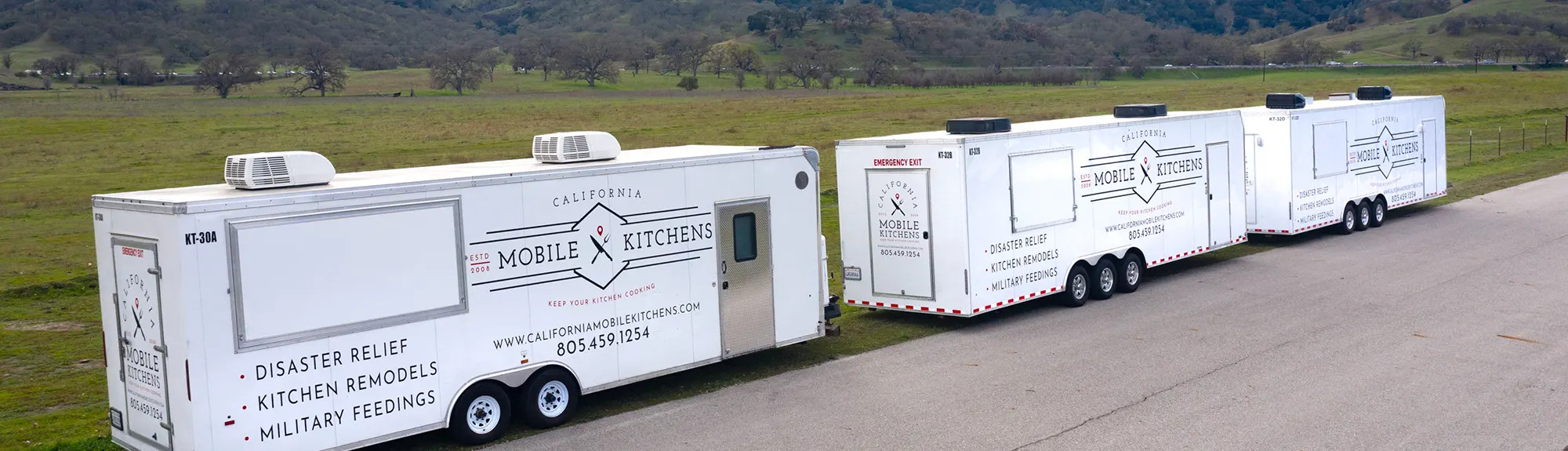
Mobile Kitchen Trailer Site Requirements: Power, Water, Wastewater and Propane Explained
Most temporary kitchen projects do not stall on the kitchen. They stall on the site: the pad is not level, the power is the wrong service, or there is nowhere for wastewater to go. All solvable — if you check them before delivery day, not on it.
California Mobile Kitchens (CMK) kitchen trailers use one standard utility profile. This guide walks through what your site needs, what to check for each utility, and your options when a connection is missing.
The standard requirements at a glance
Every CMK kitchen trailer needs:
- Power: 208–220V single-phase, 50-amp
- Fresh water: 3/4-inch connection
- Wastewater: 1 1/2-inch connection
- Propane: where required
- Ground: a level setup area with clear truck access for delivery
Tell us about your site when you request a quote and we will confirm what your setup needs. That one conversation, early, is what keeps delivery day simple.
Power: 208–220V single-phase, 50-amp
Power is the first thing to verify, because it is the hardest to improvise at the last minute.
Your site needs 208–220V single-phase 50-amp service available where the trailer will sit — not just somewhere on the property. Distance matters: a panel on the far side of a building is a different job from a panel near the setup area, so note where your service is in relation to where the trailer will go.
Questions to answer before you book:
- Do you already have 208–220V single-phase service on site?
- Is there a 50-amp connection available, or will an electrician need to add one?
- How far is the panel from the planned trailer location?
If your site does not have the right power — a remote location, a field site, or a property where adding service is not practical — ask about a generator when you request a quote. A generator is an available add-on, priced by quote, and planning it in advance is far easier than arranging power after the trailer is placed.
Support trailers are different. CMK refrigeration and freezer trailers operate on a simple 110V electrical connection, so cold storage is usually the easiest utility on the site to place.
Fresh water: 3/4-inch connection
The kitchen needs a 3/4-inch fresh water connection at the setup area. Confirm that a suitable supply point exists near the trailer location, that it will be available for the full rental period, and who on your team is responsible for it on delivery day. On a months-long job — a cafeteria renovation, a hospital remodel, a long construction project — note it on your site plan alongside the trailer position.
Wastewater: 1 1/2-inch connection — and the no-sewer option
Wastewater is the requirement people most often overlook. The kitchen trailer needs a 1 1/2-inch wastewater connection, so used water from cooking and cleaning has somewhere approved to go.
Start with one question: does your setup area have a sewer connection the trailer can tie into?
If yes, confirm its location and size with your facilities team before delivery.
If no, you are not stuck. Ask about the 250-gallon waste holding tank option when you request a quote — an add-on that gives no-sewer sites a workable plan. Pumping for a multi-day or long-term rental also needs scheduling, and arrangements depend on your area and dates, so raise it early. Wastewater is a health-permit and logistics item as much as a plumbing item, and it is the one most likely to delay an otherwise ready site.
Propane: where required
Propane is required where the kitchen's equipment calls for it, so plan fuel like power. Confirm where tanks can be placed and how service will be handled during the rental. CMK offers propane service as an add-on, priced by quote — settle that plan at booking, rather than when the first tank runs low.
The ground itself: level, accessible, and planned
Utilities are only half of site readiness. The trailer also needs a level setup area, and the delivery truck needs clear access to reach it:
- Is the ground level where the trailer will sit, or does it need preparation?
- Can a truck delivering a 20-foot or 32-foot trailer get in, position the unit, and get out?
- Will anything — parked vehicles, construction staging, event fencing — block access on delivery day?
- If you are adding ADA ramps and decking, has that space been allowed for around the trailer?
Support trailers and add-ons need room on the same plan. Sketch the full layout once, with every unit on it, instead of placing the kitchen first and fitting the rest around it.
Permits still sit with you
Customers obtain their local health permits, with documentation supplied by CMK. Your utilities plan feeds directly into that permit process — inspectors care about water, wastewater, and a sanitary setup — so a site that is utility-ready is also a site that is easier to permit. Start the permit conversation when you book, not when the trailer is scheduled.
Match the site plan to the kitchen size
Site requirements do not change with trailer size — both sizes use the same utility profile — but capacity does:
- 20-foot kitchen trailer — $6,000 per month. Serves 1–300 meals per meal.
- 32-foot kitchen trailer — $8,000 per month. Serves up to 1,000 meals per service.
Delivery and setup are covered in the lease agreement, so the full pricing — including delivery and setup — is in the lease before you sign. Add-ons, including a generator, ADA ramps and decking, a waste holding tank, and a grease trap, are priced by quote. A dishwashing trailer is a separate 24-foot unit — kitchen trailers do not include a dishwasher — so include it in your layout if your service uses real plates, pots, and utensils at volume.
A simple site checklist to send with your quote request
When you contact CMK, include:
- Your site address and where on the property the trailer will sit
- Your power service and panel location
- Your fresh water connection point
- Your sewer tie-in, or a note that you need the holding tank option
- Your dates, meal count per service, and menu
- A note on ground level and truck access
- Any support trailers or add-ons you think you need
That list lets us confirm your setup, recommend the right combination, and flag any gap while there is still time to fix it.
How a rental is confirmed
Your rental is confirmed once three things are in place: the lease is signed, payment is satisfied, and the certificate of insurance (COI) is received. Once confirmed, CMK schedules delivery and setup. With 24-hour customer service, CMK is ready to help you plan even the smallest details, all within your budget.
Request a quote
Ready to check your site? Fill out the Get Quote form on our website, call (805) 459-1254, or email tommy@californiamobilekitchens.com. Tell us your location, your dates, your meal count, and what your site has for power, water, and wastewater, and we will confirm the right setup for your job. Keep your kitchen cooking.