

Disaster Relief Mobile Kitchen Rental in California: How to Keep Feeding People When Your Kitchen Is Down
When a fire, flood, earthquake, power outage, or facility failure takes a kitchen offline, the meals do not stop being needed. Residents, patients, students, crews, and displaced families still need to eat — often in larger numbers, and often in a place that was never built to be a kitchen.
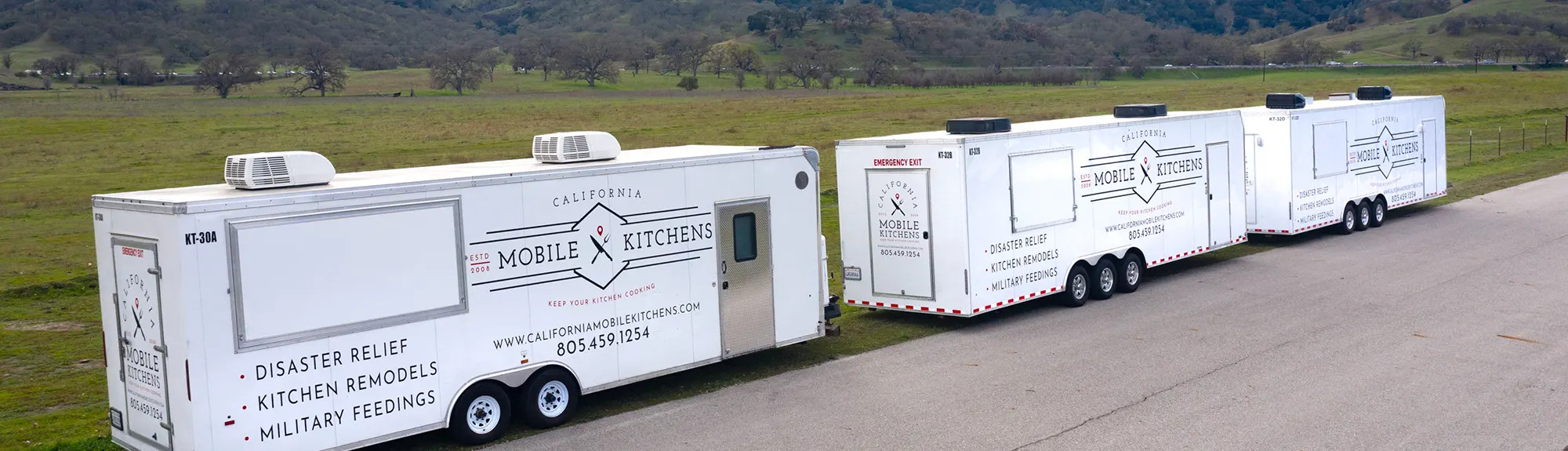
A disaster relief mobile kitchen rental puts a fully equipped commercial kitchen trailer on site, so feeding can continue where people actually are. California Mobile Kitchens (CMK) delivers and sets up kitchen trailers across California and nationwide, with 24-hour customer service. In an emergency deployment, CMK can also provide the meal service itself with kitchen trailer support — a full feeding operation — while day-to-day rentals remain equipment and infrastructure for your own team or caterer to cook in.
This guide is for the person who has to make that call: what to size, what a site needs, and what to tell us on the first phone call so nothing is lost to back-and-forth.
Size to meals per service, not to headcount alone
Emergency feeding is bursty. A shelter, a crew camp, and a damaged facility all serve differently, but each one has a peak: the largest number of meals that must come out in a single service.
CMK rents two main kitchen trailer sizes:
- 20-foot kitchen trailer — $6,000 per month. Serves 1–300 meals per meal.
- 32-foot kitchen trailer — $8,000 per month. Serves up to 1,000 meals per service.
Delivery and setup are covered in the lease agreement, so the full pricing — including delivery and setup — is in the lease before you sign.
If you are feeding in shifts, say so. Three services of 300 are a different operation from one service of 900, even though the daily total looks similar. Menu matters too: a simple hot meal served from a line needs less prep and holding room than a full menu with multiple components. Give us meals per service, services per day, and the menu you realistically plan to serve, and we will recommend the size that fits — not just the largest trailer available.
Cooking is only one link in an emergency setup
A feeding operation that only solves cooking will stall on dishes, prep, or cold storage within the first day. Plan the whole chain:
Dishwashing. A kitchen trailer does not include a dishwasher. Dishwashing gets its own dedicated 24-foot dishwashing trailer, so trays, pans, and utensils keep moving between services instead of piling up while the next meal is due.
Prep space. A 32-foot prep kitchen trailer adds dedicated room to wash, chop, mix, assemble, and stage food alongside the kitchen trailer. At high volume, prep room is often what decides whether the line keeps up.
Cold storage. Refrigeration and freezer trailers — 12-foot and 16-foot — hold ingredients and prepared food on site. They run on a simple 110V electrical connection, which makes them the easiest units to place at a temporary site.
Add-ons. Available by quote: a generator when site power is down or insufficient, a 250-gallon waste holding tank when there is no sewer connection near the setup area, ADA ramps and decking for accessible entry, and a grease trap. In a disaster setup, the generator and the waste tank are the two add-ons to decide first — they answer the two questions every temporary site asks: where does the power come from, and where does the wastewater go?
You add only what your operation needs. A single damaged restaurant, a school used as a shelter, and a multi-week recovery feeding site will not — and should not — end up with the same layout.
What an emergency site needs
Every CMK kitchen trailer uses the same standard utility profile:
- Power: 208–220V single-phase, 50-amp
- Fresh water: 3/4-inch connection
- Wastewater: 1 1/2-inch connection
- Propane: where required
- Ground: a level setup area with clear truck access for delivery
A disaster site may not have all of that in one spot — that is normal, and it is exactly why the site conversation comes first. If power is out, a generator can be part of the quote. If there is no sewer connection near the setup area, ask about the 250-gallon waste holding tank, which sits above ground in line with the 1 1/2-inch wastewater connection, with pump-outs arranged for longer deployments. If fresh water has to come from a temporary source, tell us what is available and we will confirm what the setup needs before delivery, not after the trailer arrives.
Location matters as much as utilities. The trailer needs to sit where a truck can deliver it, utilities can reach it, and the serving line, deliveries, and foot traffic do not collide. Sketch the full layout once — kitchen, dishwashing, prep, cold storage, serving point, and waste — instead of placing the kitchen first and fitting everything else around it.
Permits, confirmation, and getting started
Customers obtain their local health permits, with documentation supplied by CMK. CMK trailers are built to meet or exceed state and county health department requirements. In an emergency, start that conversation at the same time you book — do not wait until the trailer is on the ground.
A rental is confirmed once the lease is signed, payment is satisfied, and the certificate of insurance (COI) is received. Once confirmed, CMK schedules delivery and setup. Knowing that sequence up front helps an agency, facility, or business move fast without skipping a step that would hold delivery later.
On the first call, have ready if you can: the site address, meals per service and services per day, your planned menu, what the site has for power, water, and wastewater, how long you expect to feed, and whether you need CMK equipment only or a full emergency meal service. If you do not have all of it, call anyway — we will work through it with you.
What it costs, in context
The kitchen trailer itself is $6,000 per month for the 20-foot or $8,000 per month for the 32-foot, with support trailers and add-ons priced by quote and full pricing — including delivery and setup — set out in the lease. The comparison in an emergency is rarely trailer versus nothing. It is trailer versus no hot meals at all, versus transporting food in from a distant kitchen and losing time and temperature on every run, or versus keeping a damaged facility limping along past what it can safely do. An on-site kitchen keeps feeding where the people are, for as long as the recovery takes.
Request a quote
Facing an emergency, a planned outage, or a facility closure? Fill out the Get Quote form on our website, call (805) 459-1254, or email tommy@californiamobilekitchens.com. Tell us your site, your meals per service, and what utilities you have, and we will recommend the right combination — kitchen, dishwashing, prep, cold storage, and add-ons — for your operation. With 24-hour customer service, CMK is ready to help you plan even the smallest details. Keep your kitchen cooking.